


How to Verify Vintage Turquoise Authenticity: A 2026 Guide

Table of Contents
Essential Non-Destructive Tests for Vintage Turquoise Authenticity
Identifying Authentic Sterling Silver Jewelry Marks
How to Tell If Turquoise Is Stabilized: A Collector's Guide
Stabilization vs. Reconstituted Turquoise: Key Differences
Stabilized vs. Dyed vs. Natural: A Three-Way Comparison
Vintage Native American Jewelry Authentication: What to Look For
Geological Origin Indicators and Matrix Patterns
Visual Inspection: Color, Matrix, and Fracture Patterns
Weight, Temperature, and Hardness Testing on the Mohs Scale
Common Mistakes and When to Seek Gemological Inspection
Frequently Asked Questions
Last Updated: September 16, 2026
Essential Non-Destructive Tests for Vintage Turquoise Authenticity
Most guides tell you to reach for a needle and a bottle of acetone. On a vintage piece, that advice is backwards. The hot needle test can scar a soft stone, and acetone can dull or cloud stabilized material, both outcomes permanently reduce value on a piece you may have paid hundreds for. The tests below leave the stone exactly as you found it.
Turquoise is a hydrated copper aluminum phosphate mineral that forms in arid, copper-rich environments, which is why its color ranges from sky blue to blue-green depending on copper and iron content. That chemistry gives you several passive signals that require no tools at all.
Reflected light inspection. Hold the piece under a bright, angled light, a jeweler's loupe light or even a phone flashlight works. Natural turquoise shows depth: color that shifts as you tilt the stone, with lighter and darker zones following the mineral's internal structure. Dyed howlite and magnesite look flat because the dye sits on the surface. Rotate the piece slowly and watch for color that stays locked in place.
Loupe inspection of the surface. A 10x loupe reveals what the naked eye misses. Look for air bubbles, molded seams, or a uniform plastic-like sheen, all signs of resin or plastic. Natural turquoise shows tiny pits, irregular polish marks, and matrix that sits flush with or slightly below the surrounding stone rather than painted on top.
UV fluorescence. Under a longwave ultraviolet light, many resin-treated and plastic imitations fluoresce, they glow a chalky blue-white or greenish haze. Natural, untreated turquoise typically does not fluoresce. Stabilized turquoise may show a faint reaction depending on the resin used, so treat fluorescence as a red flag rather than a verdict. Inexpensive UV pen lights are widely available and fit in a pocket.
Weight and temperature in the hand. Natural stone has heft for its size and feels cool on first contact, warming slowly. Plastic feels light and warms almost immediately. This is a quick field filter, not a conclusion.
Specific gravity, done carefully. A small digital scale and a beaker of water let you measure density without touching the stone's surface. Real turquoise falls around 2.6 to 2.8; plastic sits closer to 1.2. The setup costs less than a single appraisal and is the most reliable non-destructive measurement available to a collector at home.
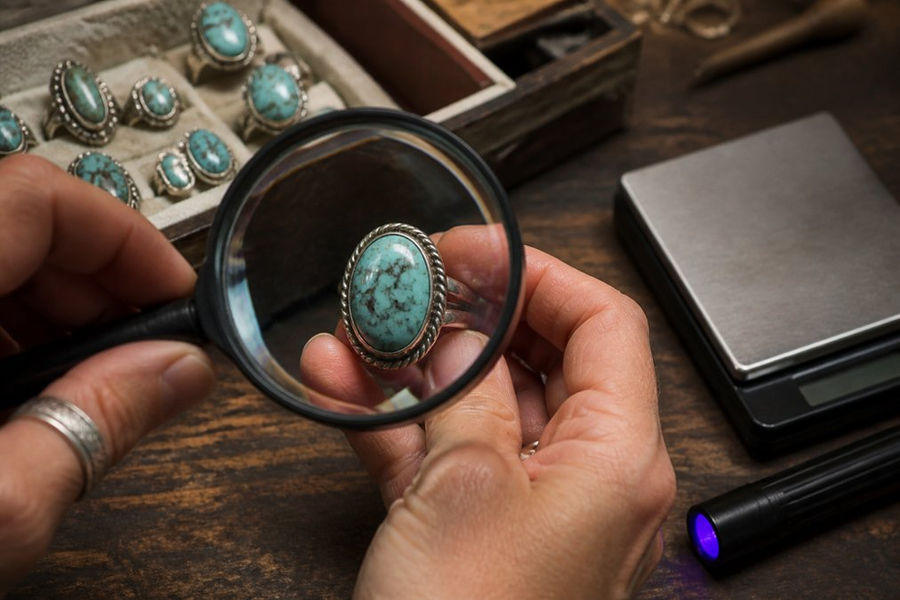
Watch Out Skip the hot needle and acetone tests on any finished, high-value piece. One slip can leave a permanent burn mark or a dulled surface that drops resale value instantly. If you must test, use the back of a bezel on a low-value piece, or better, rely on the non-destructive methods above and let a gemologist settle the question.
Pro Tip Build a reference set. Handle known-natural, known-stabilized, and known-imitation stones side by side under the same light. Most collectors find that after a dozen comparisons, weight, luster, and color depth become reliable instincts, no tools required.
Identifying Authentic Sterling Silver Jewelry Marks
Sterling silver marks are your fastest shortcut to vintage turquoise authenticity because they date a piece and confirm its metal content. Genuine sterling silver in the United States is stamped "925," "Sterling," or "Sterling Silver," a standard enforced under the National Gold and Silver Stamping Act.
Hallmarks vary by era and maker. A "925" stamp alone tells you the metal is 92.5% silver. A maker's mark, like a stamp from a known Navajo or Zuni artisan, adds provenance. Stamps reading "coin silver" usually point to pre-1900 pieces, while "sterling" stamps became standard in the early 20th century.
What most guides miss is that a missing hallmark doesn't mean a piece is fake. Many hand-cut Native American pieces from the mid-century were never stamped, especially those sold directly by artists.
Pro Tip Look for hallmark placement consistency. Genuine vintage stamps are often uneven, slightly off-center, or worn from decades of polishing. Laser-etched modern stamps are perfectly crisp and uniform, which is a red flag on a piece claiming to be vintage.
How to Tell If Turquoise Is Stabilized: A Collector's Guide
Stabilized turquoise is real turquoise that has been treated with a resin, usually a clear epoxy or acrylic, to harden it and, in some cases, deepen its color. This is the single most misunderstood part of vintage turquoise authenticity, because stabilization is not the same as faking. A stabilized stone is a genuine mineral; a fake is not.
Most turquoise on the market today is stabilized. The stone is naturally porous, and untreated material often crumbles during cutting.
Stabilization vs. Reconstituted Turquoise: Key Differences
Reconstituted turquoise is not real stone in any meaningful sense. It's made from turquoise dust and fragments mixed with resin and pressed into blocks. Stabilized turquoise is a single natural stone with treatment. Reconstituted turquoise is a manufactured composite.
Stabilized vs. Dyed vs. Natural: A Three-Way Comparison
The confusion most collectors run into is treating 'stabilized' and 'dyed' as the same thing. They aren't.
Natural (untreated): No resin, no dye. Porous, often softer, and the most valuable when the color and matrix are strong. Rarer in vintage pieces than most buyers assume.
Stabilized (no dye): Resin only. The stone's natural color is preserved; hardness and durability improve. Common in mid-century and later Native American jewelry.
Stabilized and dyed: Resin plus colorant. The stone is real, but the color you see may not be the color it formed with. Value drops relative to an undyed stone of the same quality.
Reconstituted: Turquoise dust plus resin, pressed into blocks. Not a single natural stone. Costume value only.
Key Takeaway Stabilization is a treatment, not a fake. Dye is a colorant, not a fake. Reconstitution is a fake. Learn to name which one you're holding and you'll avoid both overpaying and unfairly rejecting good vintage pieces.
Pro Tip Ask the seller directly: 'Is this stone natural, stabilized, or stabilized and dyed?' A knowledgeable seller will answer without hesitation. A vague answer, or a claim that every stone is 'natural', is your cue to look elsewhere.
Vintage Native American Jewelry Authentication: What to Look For
Authenticating vintage Native American jewelry requires more than testing the stone. You're also verifying the craftsmanship, the silversmithing style, and the regional design language.
Geological Origin Indicators and Matrix Patterns
The matrix is the dark veining or webbing running through turquoise, and it's one of the hardest features to fake convincingly. Natural matrix follows the stone's fracture patterns and looks organic, like a river system. Fake matrix painted or glued onto howlite or magnesite looks too linear or too evenly distributed.
Key Takeaway The matrix is your best non-destructive authenticity signal. If the webbing looks painted, too uniform, or doesn't follow natural fracture lines, the stone is almost certainly treated or fake.
Visual Inspection: Color, Matrix, and Fracture Patterns
Color is the first thing most buyers notice and the easiest thing to fake. Natural turquoise shows tonal variation across a single stone, subtle shifts from blue to green, lighter patches near the edges, and depth that changes with the light.
Weight, Temperature, and Hardness Testing on the Mohs Scale
Natural turquoise sits between 5 and 6 on the Mohs hardness scale, which makes it softer than quartz but harder than most plastics. This range gives you a few passive tests that require no tools.
Common Mistakes and When to Seek Gemological Inspection
The biggest mistake collectors make is trusting a single test. No test is conclusive on its own. A stone can pass the acetone test and still be reconstituted. A piece can have a proper hallmark and still hold a fake stone.
Test | What It Reveals | Risk Level | Best For |
Visual inspection | Color, matrix, fracture patterns | None | Every piece, always first |
Hallmark check | Metal content, maker, era | None | Sterling silver pieces |
Acetone swab | Surface dye on howlite or magnesite | Low | Suspected dyed stones |
Hot needle | Plastic or resin imitations | High | Low-value pieces only |
Weight and temperature | Plastic vs. natural stone | None | Quick field checks |
Specific gravity | Mineral density confirmation | None | Serious purchases |
Gemological inspection | Definitive identification | None | High-value or disputed pieces |
Frequently Asked Questions
How do you test turquoise to see if it's real?
Start with non-destructive methods: check for natural matrix patterns and tonal variation under a loupe, feel for a waxy luster, and look for hand-cut cabochon shapes. A hot needle test on an inconspicuous spot should produce no melting or plastic smell for natural or stabilized turquoise. The acetone test checks for dyeing, as real turquoise won't bleed color. If results are unclear, seek a gemological inspection before buying.
How can you tell if turquoise is stabilized or treated?
Stabilized turquoise has resin infused to reduce porosity, making it harder and less likely to change color over time. Look for a slightly plastic feel, uniform color saturation without natural dents, and a lack of chalky texture. Under magnification, stabilized stones may show resin-filled fracture patterns. Reconstituted turquoise, made from dust and resin, often lacks distinct matrix and feels lighter. Ask sellers directly about stabilization, as it's common in vintage pieces.
What does fake turquoise look like?
Fake turquoise, often made from howlite or magnesite dyed blue, shows unnatural color saturation, uniform veining, and a glossy surface. Plastic imitations feel warm and lightweight, while resin fakes may have air bubbles. Check for consistency in matrix patterns, as real stones have irregular, natural dents. The acetone test will reveal dyeing if color rubs off. Also, fake pieces often lack the specific gravity and cool temperature of genuine turquoise.
What are the signs of high-quality vintage turquoise?
High-quality vintage turquoise shows deep, even color without dye pooling, a waxy luster, and sub-translucent areas. The matrix should be natural and integrated, not painted or glued. Look for hand-cut cabochon shapes and sturdy sterling silver settings with proper hallmarks. Weight and cool temperature feel are good indicators. Pieces from known Native American artists or with geological origin indicators like specific copper content add value. Always verify sterling silver marks to confirm authenticity.
BOOK AN APPOINTMENT


Comments